

A National Care Service will not be built in Whitehall alone
by Jonathan Taylor, Co-Lead of Community, Home and Social Care theme
“Let’s have the courage to fix the big things that politics has neglected – like social care.”
ANDY BURNHAM
Andy Burnham made social care one of the defining themes of his first speech as Labour leader. Minutes after becoming Prime Minister, he reinforced that commitment, promising to “put the care of people at the heart of everything I do”.
Burnham has since called for cross-party agreement on social care, acknowledged that successive governments and political parties have failed to resolve the issue, and warned that the NHS will collapse unless social care is reformed.
These are ambitious words. They also arrive at a familiar moment: another government, another promise, and another opportunity to ask whether social care reform can finally move from aspiration to action.
If social care is to move from political commitment to practical improvement, we need to be clear about the nature of the task. The central challenge is not a shortage of ideas. England has had many reviews, proposals, models and commissions. The tougher challenge is building the capability to learn which approaches work, for whom, in what circumstances, at what cost, as well as how they can be implemented and sustained across different local systems.
This is where applied research has a distinctive contribution to make.
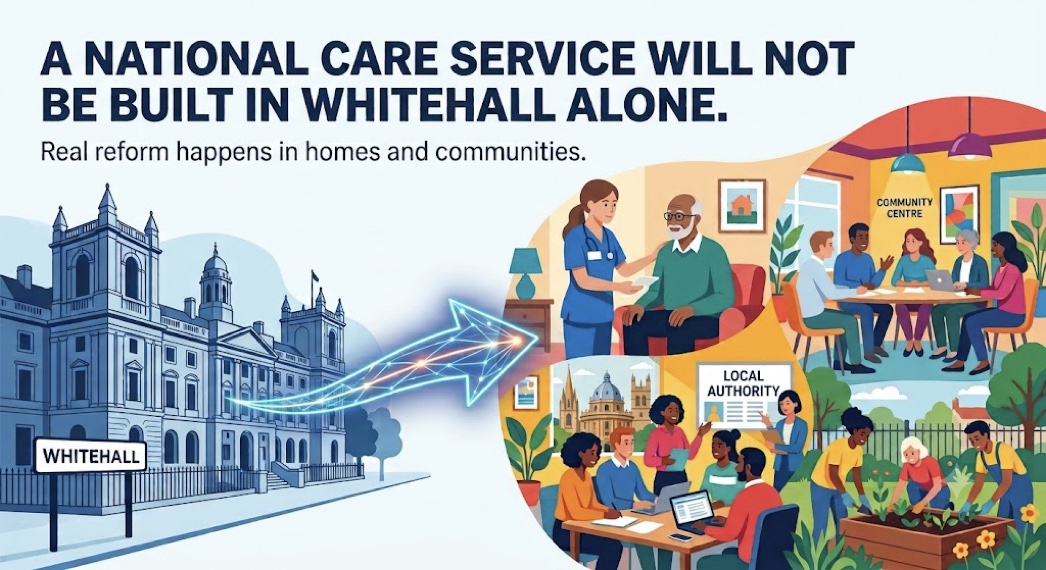
The Casey Review’s work on a National Care Service creates an important opportunity to think beyond the immediate politics of reform. A national settlement will be necessary. But a National Care Service will not be built in Whitehall alone. It will be built in homes, local communities, council teams, care providers, voluntary organisations and Integrated Care Boards.
Its success will depend on whether local systems have the relationships, evidence and implementation capacity needed to turn national ambition into better support.
The NIHR Applied Research Collaboration (ARC) Thames Valley is well placed to contribute to this task. As one of 11 NIHR ARCs across England, we can work with local partners to refine and scale interventions that already show promise, generate real-world evidence about how they work in different settings, and support implementation in the places where care is delivered.
The two social care themes within ARC Thames Valley bring complementary perspectives. The Planning and Delivering Social Care theme focuses on commissioning, organisational culture, prevention, workforce and the ethical use of digital technologies. The Community, Home and Social Care theme is developing partnerships to evaluate innovative services, identify effective home- and community-based approaches, and translate evidence into practical decisions. Together, they connect policy and system design with the realities of sustainable implementation.
Too often, promising social care interventions fail to move from early evidence to sustained adoption. Enthusiasm grows and initial findings look positive, but wider implementation stalls. The evidence may be too thin or may not yet show how the intervention performs in the varied conditions where it is expected to operate. Commissioners may lack the data or confidence to invest. Workforce pressures and budget constraints may make adoption unrealistic. The people most affected by the change may not have been involved early enough in shaping it.
A more mature reform agenda should ask not only whether an intervention works, but also for whom it works, under what local conditions, at what cost and with what implications for the workforce and unpaid carers. It should ask what commissioners need to judge value, what adaptations different communities require, and what is needed to sustain successful approaches beyond their initial implementation.
These are applied research questions, but they are also system leadership questions.
The future of social care will depend heavily on prevention and community-based care. That phrase can sound abstract, but its practical meaning is clear. It means supporting people, families and communities before avoidable crises occur. It means helping carers before exhaustion leads to breakdown. It means strengthening home-based support, improving transitions from hospital to home, recognising and supporting local voluntary and community assets, and ensuring that digital and data tools support human care rather than add complexity to already stretched services.
This requires local learning systems: partnerships that can identify priorities, refine promising approaches, evaluate impact, share learning, adapt delivery and scale what is effective. Implementation science is central here because it takes seriously the gap between evidence and practice. It asks how change actually happens in organisations, professional cultures, commissioning arrangements and everyday work.
Research capacity in social care is therefore not a luxury; it is part of the infrastructure of reform. Yet, compared with healthcare, social care has historically received far less investment in research and innovation. It has been less visible to policymakers and funders, with weaker data infrastructure, fewer research posts, less embedded evaluation and more limited capacity to translate evidence into commissioning and service improvement. If we want evidence-informed commissioning, we need to invest in the evidence ecosystem that makes it possible.
Lived experience is equally important. Research shows that many people do not yet have a clear understanding of the breadth and depth of social care, how it is provided or why it may matter to them. Reform cannot assume public support; it has to build it. That means involving people who draw on care, unpaid carers, care workers and communities not only as consultees but also as partners in setting priorities, designing research, interpreting findings and shaping implementation. It also means recognising the value of what already works well each day, rather than presenting social care only through the language of crisis and failure.
Communities of practice can play a valuable role in this work. At their best, they create spaces where practitioners, commissioners, researchers and people with lived experience learn together. They help move knowledge across organisational boundaries. They make improvement less dependent on isolated champions and more embedded in shared practice.
The opportunity now is to connect national reform with this local capability. The Casey Review can help define the direction of travel. Political leadership can create permission and urgency. But the credibility of reform will rest on whether people see practical improvements in the places where care is experienced.
For those working in applied health and social care research, the call to action is clear: strengthen the evidence for community-centred, preventative and sustainable models of care; help local systems refine and scale promising approaches; improve the connections between research, commissioning and practice; and ensure that public involvement and lived experience shape the questions from the beginning.
Fixing social care will require national courage. It will also require local learning, disciplined implementation and sustained collaboration.